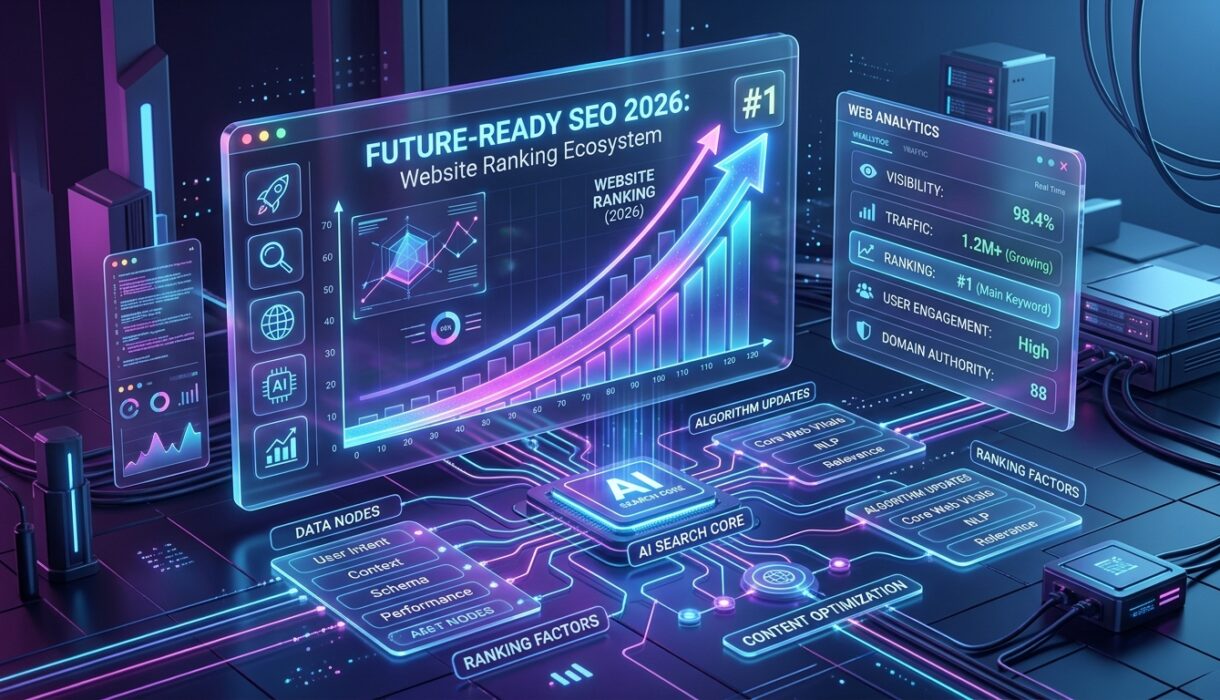
How to Rank a Website in 2026: The Definitive SEO & AI Search Guide
Posted in :

Search Engine Optimization in 2026 is no longer about chasing isolated keywords or accumulating low-quality backlinks. With Google AI Overviews, SearchGPT, Perplexity, and conversational search answering user queries directly in the SERP, ranking today demands a holistic synthesis of Generative Engine Optimization (GEO), rigorous E-E-A-T, semantic entity clustering, and high-performance technical architecture. This comprehensive guide breaks down the exact blueprint you need to rank #1 and capture AI citation traffic in 2026.
⚡ Key Takeaways: Ranking in 2026 at a Glance
- AI Answer Engines Dominate: Over 40% of transactional and informational searches trigger AI Overviews. Optimizing for direct factual citability (GEO) is mandatory.
- Information Gain > Content Volume: Google actively penalizes generic regurgitated content. You must provide unique data, original research, or first-hand operational insight.
- Entity-Based Topic Clusters: Search engines understand concepts, brands, and authors as entities. Hub-and-spoke content architectures establish indisputable topical authority.
- Core Web Vitals & INP: Interaction to Next Paint (INP) below 200ms and ultra-fast mobile rendering are baseline hygiene for organic visibility.
- Omni-Channel Brand Signals: Citations on Reddit, YouTube, GitHub, industry publications, and Google Business Profiles feed into search engine trust graphs.
1. The 2026 Search Landscape: Beyond the 10 Blue Links
For two decades, SEO was largely predictable: research high-volume keywords, craft a 1,500-word article, acquire targeted anchor-text links, and claim a spot among the classic ten blue links. In 2026, the search interface has fundamentally transformed.
Modern search engines like Google use multi-modal foundational models to synthesize direct answers before a user ever reaches standard web listings. Simultaneously, platforms like Perplexity, ChatGPT Search, and Gemini have become primary discovery engines for millions of high-intent buyers.
The Zero-Click Reality and AI Citations
While zero-click searches have risen, the traffic that does click through has substantially higher commercial intent. The goal is no longer just ranking for impression count; it is becoming the primary verified source cited by AI answer modules. When an AI answer engine quotes your data, your click-through conversion rates often double compared to traditional organic listings.
2. Generative Engine Optimization (GEO): How to Get Cited by AI Models
To rank in AI-synthesized responses, your content must be structured for easy ingestion, verification, and quotation by LLMs. Here are the core pillars of Generative Engine Optimization (GEO) in 2026:
- Answer-First Inverted Pyramid: Provide direct, definitive answers in the first 40–60 words of each section before diving into nuances and secondary points.
- Statistic & Claim Grounding: AI engines prioritize assertions backed by named authorities, exact dates, and verified primary data. Replace vague statements like “many businesses fail” with “According to a 2025 study by Harvard Business Review, 68% of SMEs struggle with customer retention due to fragmented CRM data.”
- Structured Tabular Comparisons: LLMs parse markdown tables, structured lists, and defined key-value pairings with dramatically higher accuracy than narrative walls of text.
- Quotable Definitions: Provide self-contained, one-sentence definitions of key terms that AI models can lift directly into their answer panels.
| Dimension | Traditional SEO (2020–2023) | Modern Ranking Strategy (2026) |
|---|---|---|
| Targeting | Exact-match keywords & query volume | Entity recognition, semantic intent & conversational context |
| Content Quality | Word count, keyword density & Skyscraper content | Information gain, primary research & practitioner insights |
| E-E-A-T | Author bios and social links | First-hand case studies, verified credentials & web-wide entity footprint |
| Technical Focus | Page speed & basic XML sitemaps | INP < 200ms, crawl efficiency, Schema.org graph & clean DOM |
| Link Acquisition | Guest posts, directory outreach & PBNs | Digital PR, genuine industry citations & co-occurrence in trusted corpora |
3. Building Topical Authority with Semantic Content Clusters
Modern search algorithms do not evaluate articles in a vacuum. Google uses complex Knowledge Graphs to gauge whether your domain possesses sufficient topical depth to be considered an authoritative source on a given subject.
The Hub-and-Spoke Architecture
Rather than publishing random disparate posts, structure your website into cohesive hubs and spokes:
- The Pillar Page (Hub): A broad, definitive overview that covers the high-level topic comprehensively (e.g., “The Complete Guide to SEO Services in Nepal” or “Enterprise Performance Marketing”).
- Cluster Articles (Spokes): In-depth drill-downs addressing specific subtopics (e.g., “How to Optimize for Interaction to Next Paint”, “Local SEO for Kathmandu Businesses”, “E-commerce Schema Best Practices”).
- Bidirectional Hyperlinks: Every cluster page links back to the pillar with descriptive anchor text, and the pillar references each cluster. This tells crawler algorithms that your site has exhaustive domain coverage.
4. Radical E-E-A-T: Demonstrating Unmistakable Real-World Experience
With millions of generic AI-generated articles flooding the web every month, Google has doubled down on its Experience, Expertise, Authoritativeness, and Trustworthiness (E-E-A-T) criteria. To stand apart, you must present signals that an AI model cannot replicate:
- Real-World Case Studies: Include real analytics screenshots, actual revenue metrics, client timelines, and concrete challenges faced during execution.
- Original Data & Surveys: Run proprietary industry surveys or aggregate your own client performance benchmarks. Original data creates a natural magnet for editorial backlinks.
- Author Bylines with Proven Credentials: Ensure articles are authored by identified practitioners with active digital footprints, LinkedIn profiles, and verified professional track records.
- Transparent Editorial Policies: Maintain accessible review dates, contact information, physical addresses, and clear disclosures regarding tools and methodologies used.
5. Technical SEO and Core Web Vitals for 2026
Great content cannot rank if search engine crawlers struggle to render your pages or if users bounce due to sluggish responsiveness. The technical baseline in 2026 requires:
- Interaction to Next Paint (INP) Under 200ms: INP has superseded FID as Google’s primary responsiveness metric. Minimize heavy JavaScript execution on the main thread and break up long tasks.
- Largest Contentful Paint (LCP) Under 2.0s: Serve modern image formats (WebP/AVIF), preload hero assets, use efficient CDN caching, and implement critical CSS inline.
- Cumulative Layout Shift (CLS) Below 0.1: Reserve explicit width and height dimensions for all media, embeds, and dynamic widgets to prevent jarring visual shifts.
- Clean JSON-LD Schema Graphs: Embed interconnected Schema.org markup connecting
Article,Organization,Person, andFAQPageinto a unified semantic graph.
6. Step-by-Step Checklist to Rank Your Website in 2026
📋 The 2026 Website Ranking Action Plan
- Conduct Intent-Gap Analysis: Check what Google AI Overviews and top organic results display for your primary query. Identify what critical questions are left unanswered.
- Map Out Entity Relations: Identify relevant industry entities in Wikidata and Google Knowledge Graph; incorporate related concepts naturally into your content.
- Create High Information Gain Content: Draft content that leads with immediate answers, supported by unique graphics, real experiments, or proprietary statistics.
- Implement Nested Structured Data: Add JSON-LD schema marking up the author, publication date, primary topics, and FAQs.
- Optimize for Mobile & Core Web Vitals: Audit your URL using PageSpeed Insights. Ensure INP < 200ms and LCP < 2.0s on 4G mobile simulations.
- Build a High-Trust Link & Mention Profile: Secure coverage in respected industry outlets, participate in authoritative podcasts, and build genuine community citations.
- Monitor AI Citation Share: Track not just traditional keyword rank, but whether your brand is cited in Perplexity, ChatGPT Search, and Google AI Overviews.
Frequently Asked Questions (FAQ)
How long does it take to rank a new website in 2026?
For a brand-new domain, ranking for competitive terms typically takes between 3 to 6 months. However, websites that establish topical authority quickly through comprehensive content clusters, flawless technical foundations, and verified E-E-A-T signals often start appearing in AI Overviews and long-tail SERPs within 4 to 8 weeks.
Is keyword research still relevant in 2026?
Yes, but the methodology has shifted from exact-match keyword targeting to semantic entity clustering and intent mapping. Search engines group thousands of related conversational queries under single overarching entities. Research now focuses on understanding user intent, answering follow-up questions, and covering topical sub-entities.
Can AI-generated content rank on Google in 2026?
Google’s official guidelines state that content is evaluated based on quality, helpfulness, and user value, not how it was produced. However, unedited, generic AI content invariably fails Google’s Information Gain criteria and struggles to earn genuine citations. The winning strategy is using AI for research and drafting, while human subject-matter experts inject real experience, data, and editorial judgment.
What is Generative Engine Optimization (GEO)?
Generative Engine Optimization (GEO) is the practice of optimizing digital content so that artificial intelligence search engines (like Google Gemini, Perplexity, and SearchGPT) easily extract, understand, and cite your brand as an authoritative reference in their generated answers.
Ready to Dominate Search and AI Citations in 2026?
Digital KB provides results-driven SEO services, technical audits, and performance marketing designed to put your business at the forefront of search engine algorithms.
